

Turn-by-turn navigation takes the whole job. You give it a destination and it picks the roads, the merges, the lane you need to be in, and the moment to leave. It is the most complete automation most people use, and most people use it without thinking about it at all.
It also has a checkbox that says avoid tolls.
That control has been in mapping products for as long as most of us have been using them, and nobody argues about it. Nobody calls it a legacy input for advanced drivers. In the most automated thing on the phone, the control that survived every round of simplification is the one that says what you do not want.
When a system takes over the doing, the most useful thing a person can still say is what to rule out. High-level intent, then disqualifiers. Take me there. Not through a toll.
The trouble starts when simplicity becomes the objective. Simplicity is a byproduct of removing what does not yield value, and it is a poor goal on its own. What a team actually wants is efficiency, or a particular outcome, or a setup flow somebody can finish. Fewer inputs is one way to get there. It is a means that gets quietly promoted to a goal, and once it is the goal you start removing inputs to hit a number.
Car controls expose another limit of simplification.
Euro NCAP’s 2026 guidance addresses basic controls buried in touchscreen menus. It asks carmakers to offer physical buttons or dedicate a fixed portion of the display to important driving functions, including windscreen wipers. A cleaner dashboard still has to leave people a dependable way to do the thing they need.
I have been on the other side of this one.
From December 2022 I led design for Performance+, Pinterest’s campaign automation. We took campaign setup from more than thirty manual decisions to three inputs: goal, budget, creative. It beat its first-year target comfortably, and it became the standard four teams shipped against.
It worked. It also showed us which of our own inputs we had thought about and which we had only assumed.
The part that went well was an argument made before the build, and a team willing to test it rather than settle it by opinion. If we were going to automate the inputs, we needed to capture more constraints, not fewer. The geographic ones and the regulatory ones especially. I put it into the Optimal Setup Framework as a hypothesis. We agreed to research it, the research supported it, and region exclusion shipped in the first version.
Region exclusions is the plainest of them. Target the whole US, exclude Alaska and Hawaii—usually because you cannot ship there.
The inputs we did not research taught the same lesson more slowly. The minimum age setting came back, the lower bound you have to be able to set on a regulated category. Then reporting breakdowns. The ones we tested we kept. The ones we assumed we paid for later.
There was a second half I was less sure about. Capturing more constraints was one thing, and capturing the inputs that carry the most signal about what a person is actually trying to do is a different thing. I had a hunch and not much else, and a hunch is a weak instrument to bring to a room with usage data and a ship date. I still think it was right. I do not know that it would have survived the same research, and that is the honest version.
The thing I keep coming back to is that the whole argument was already on my phone. Two decades of people getting into cars and saying not the toll road. Solved, shipped, boring, sitting in a product I opened every week and never thought about once. That is usually where the good version of a control is hiding, in something so ordinary that nobody writes about it, and the reason it is easy to miss is that working things do not announce themselves.
The useful part is what did not come back.
An entire category of controls stayed gone and nobody missed them. People had wanted those because they did not trust the system. Once the product could say what it had done and why, in language that matched how a person thought about their own campaign rather than how the system thought about it, the appetite for the manual lever faded and did not return. People conflate wanting to control something with wanting to understand it, and when the understanding arrives the control stops mattering.
Which gives a test for software inputs, and it is a real one because it cuts both ways.
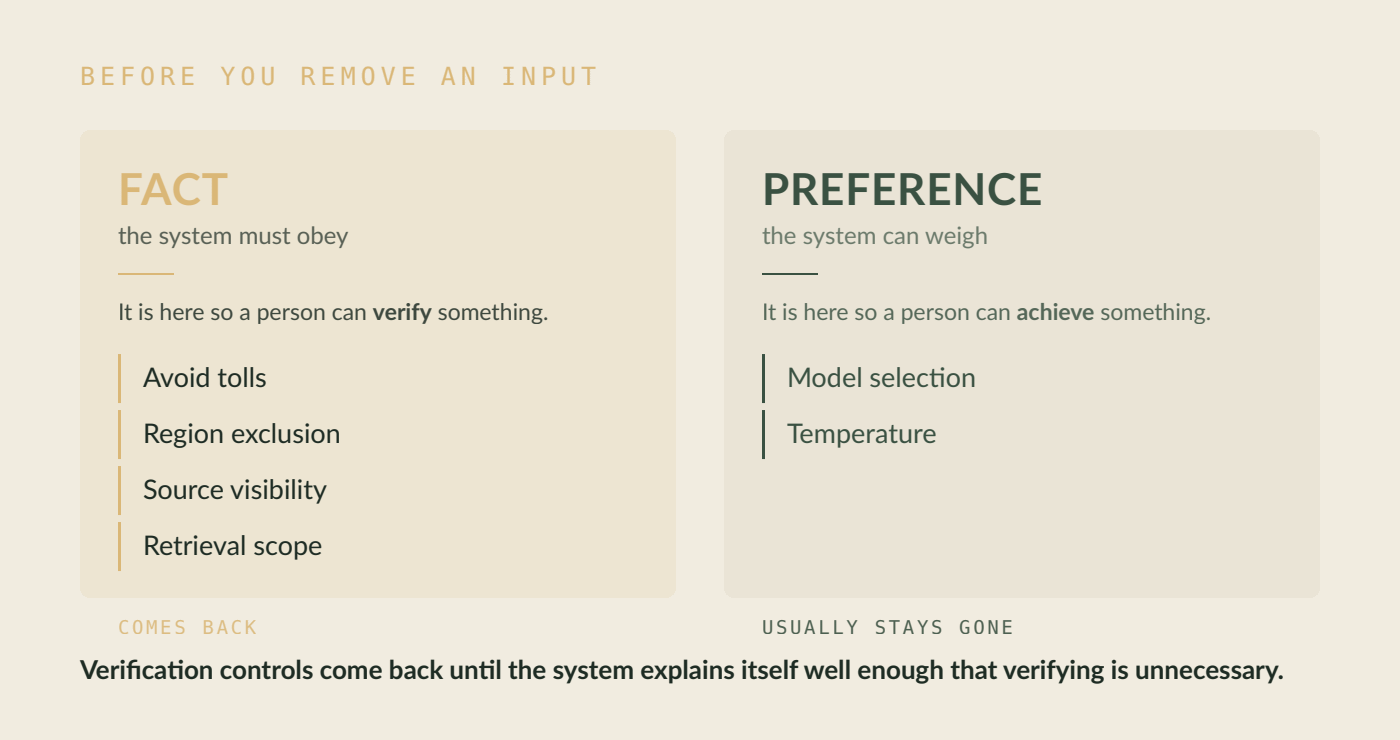
For every input you are about to remove, ask whether it is there so a person can achieve something, or so a person can verify something. Verification controls come back until the system explains itself well enough that verifying is unnecessary. Achievement controls are usually preferences.
Region exclusion is verification, and I mean that narrowly, not as a synonym for testing. There is no other way to be certain Alaska is out. Avoid tolls is the same move: the router will probably find a toll-free route, and you cannot otherwise be sure that it will. This is signals not constraints, run backwards. A preference is something the system can weigh. A fact is something the system must obey.
Being honest about the limit of my own test: it does not fully explain the car example. Operating the wipers is about getting something done, but that alone says nothing about how quickly or reliably someone needs to reach the control. What covers both sits a layer up. Removal optimizes for the average case, and a control comes back when somebody’s real situation is not the average one, which is a thing you generally cannot find out in advance because the people it lands on are not in the usage data you were reading when you decided.
Which is also why the argument for cutting is always a good argument. Usage is low. The system infers intent better than a person expresses it. And the strongest version, the one that is actually true: every input is a place where someone can make their own setup worse.
Right on average, wrong in the case that matters. Picture the person it lands on. You run a furniture business, your freight partner will not go past Seattle, and the campaign tool has decided that where your ads run is a detail it can handle for you. The only thing you want on that screen is the box that says not there. Removing region exclusion does not hurt the average advertiser at all. For that person it makes the product unusable.
The same sort is available on AI products right now, before anyone has to pay two years for it.
Source visibility is a fact. A citation is how a person confirms the answer was not invented. Nobody reads them for pleasure.
Retrieval scope is a fact. Search only these sources is the exclusion pattern exactly. Avoid tolls. Exclude Alaska.
Model selection is mostly a preference. People pick models because they do not trust the router, not because they need a particular one.
Temperature is a preference. Almost nobody wants a slider. They want output that is more or less conservative, and reaching for the slider is the only way to ask.
Here is the part with an asterisk on it, because I do not want to overclaim. I do not know where the explanation threshold sits. The test says a verification control can go once the system explains itself well enough, and I cannot tell you when that is. At Pinterest the closest we got was shipping a learning phase that said out loud when the machine was still calibrating. It helped. It did not settle it. For consequential work I suspect the threshold never fully arrives, and suspect is the honest word there.
So the question before removing an input is what people use it for. Getting something done, or being sure.
And if it is the second one, taking it away is not simplification. It is a loan against an explanation you have not built yet.
Hew Suber works on products that decide, recommend, or act on a person’s behalf, and on the hardest part of that: whether a person trusts the system enough to let it. Fractional head of product and design, seed to Series B.