
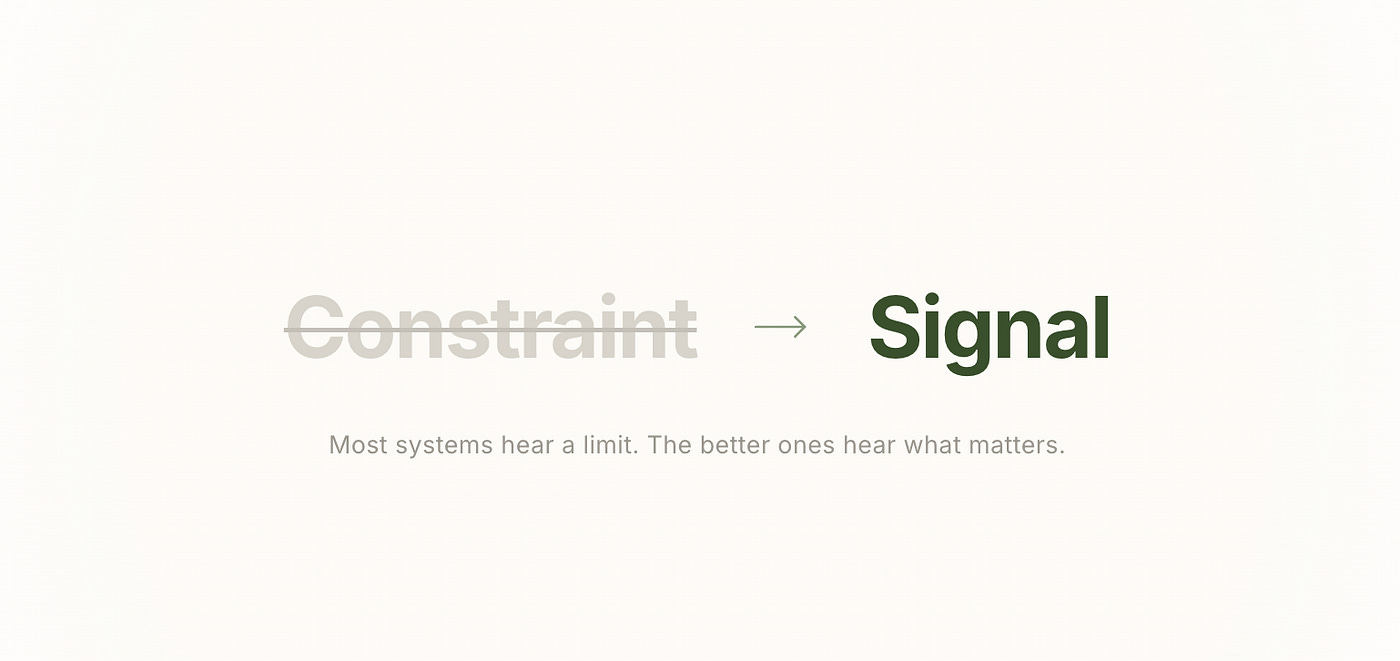
Signals, not constraints
Most systems hear a limit. The better ones hear what matters.

Originally published on Medium, May 15, 2026
An advertiser walks into a platform and says “California.” The system hears a constraint, “only California”. It narrows the targeting, filters out every other state, and delivers what was asked for. Technically correct. Functionally small.
But that’s not usually what the advertiser means. What they mean is closer to: California matters more to me right now. My best customers are there. My awareness is strongest there. If you have to choose, choose California. But don’t throw away everything else if something valuable shows up.
The difference between those two interpretations changes what the system can do.
I spent years inside an ads platform watching this play out. The product helped advertisers define their existing customers relative to other audiences so the system could find more people like them. Early on, the product treated every input as a hard rule. This audience, not that one. This budget cap, not a dollar more. The system obeyed. The results were precise and limited.
At some point the product started treating these inputs differently. Not as rules to obey but as signals of what the advertiser valued more. The advertiser isn’t saying “never spend outside California.” They’re saying “California is where I see the most return right now.” That’s not a ceiling. That’s a compass direction. A system that reads the compass can optimize in ways a system that reads the ceiling can’t.
The inputs stopped being walls and started being weights. Revenue followed.
None of this was new inside ads. Optimization systems have been learning to read intent for years. What I didn’t expect was to keep finding the same pattern outside of it.
In an AI product I’ve been working inside, analysts type queries into a chat interface. The system used to treat each query as a literal instruction. But the query was almost never the whole picture. The analyst meant something closer to: I’m working on a time-sensitive assessment, I need recent coverage of this area, and I care about resolution and recency more than format. The literal query is a constraint. The intent underneath it is a signal. I wrote about this a few months ago — the blank box problem. A product saying “you go first” to someone who came in looking for help. The connection I didn’t name then: the blank box treats whatever the person types as a finished instruction. The better version treats it as the first signal in a conversation that hasn’t happened yet.
I’m building a location sharing app. The rule engine works the same way.
A person sets a rule: Friday, after eight, at this bar, tell these three friends. On the surface that looks like a constraint. A narrow set of conditions the system is allowed to act within.
But the person isn’t defining a limitation. They’re signaling availability. Friday after eight at this bar is when I’m open to spontaneous connection with these people. The rest of the time, I’m not. The rule isn’t a wall. It’s an invitation with conditions.
Every rule in the product is like this. A friend, a distance, maybe a place, maybe a time. The person draws a boundary. But the boundary isn’t a restriction. It’s a signal of what matters more.
I notice this outside of work too.
When my kid says “I don’t want to,” sometimes my first instinct is to hear a wall. Resistance. A constraint on what we’re about to do. But it’s almost always a signal of what matters more in the moment. Sleep. Autonomy. Not being rushed. If I treat it as a wall to push against, I lose. If I treat it as information, I get to ask a different question: what’s the want underneath the don’t?
Every boundary that’s ever worked in areas like relationships, in parenting, in how I spend my time — has been a signal of what mattered more. “I can’t take meetings Friday afternoon” is a signal that Friday afternoon is when I think. “I don’t want to debate this over text” is a signal that the medium isn’t built for the weight.
A boundary that works is an invitation. Here’s what’s not available — and here’s what is.
I think there’s a principle underneath all of this that I’m still getting my arms around.
Constraints limit what’s possible. Signals reveal what matters more.
But I think this applies beyond products. Most of the time, when someone says something, the words are a starting point. The meaning is underneath.
I’m not sure I always hear the signal. I think I’m getting closer.