

The last page I built for the new site was the engagement page. I had been putting it off. Writing about the work is comfortable. Writing about what the work costs, and where it starts and stops, felt like a different job.
It is a different job. It’s product design.
Here’s the version of fractional work most founders have seen. Two people agree on a rate and a rough shape: hours per week, a check-in, a start date, good intentions. A menu. Then the asks start arriving, because asks always arrive. If you’re the founder, the math feels obvious: I’ve got a product leader twenty hours a week, so the roadmap review is covered. And the investor deck. And, honestly, the job posts too. Every single ask is reasonable. None of it is bad faith.
The engagement drifts up in scope and stays flat in price, and the operator starts quietly resenting a relationship they priced themselves. I want to be careful with the word: drift by definition, the slow kind, not an accusation. Nobody chose it. That’s the point. Nothing in the model gives either side a way to see it happening while it’s happening, so both sides discover it late, usually in the same tense week.
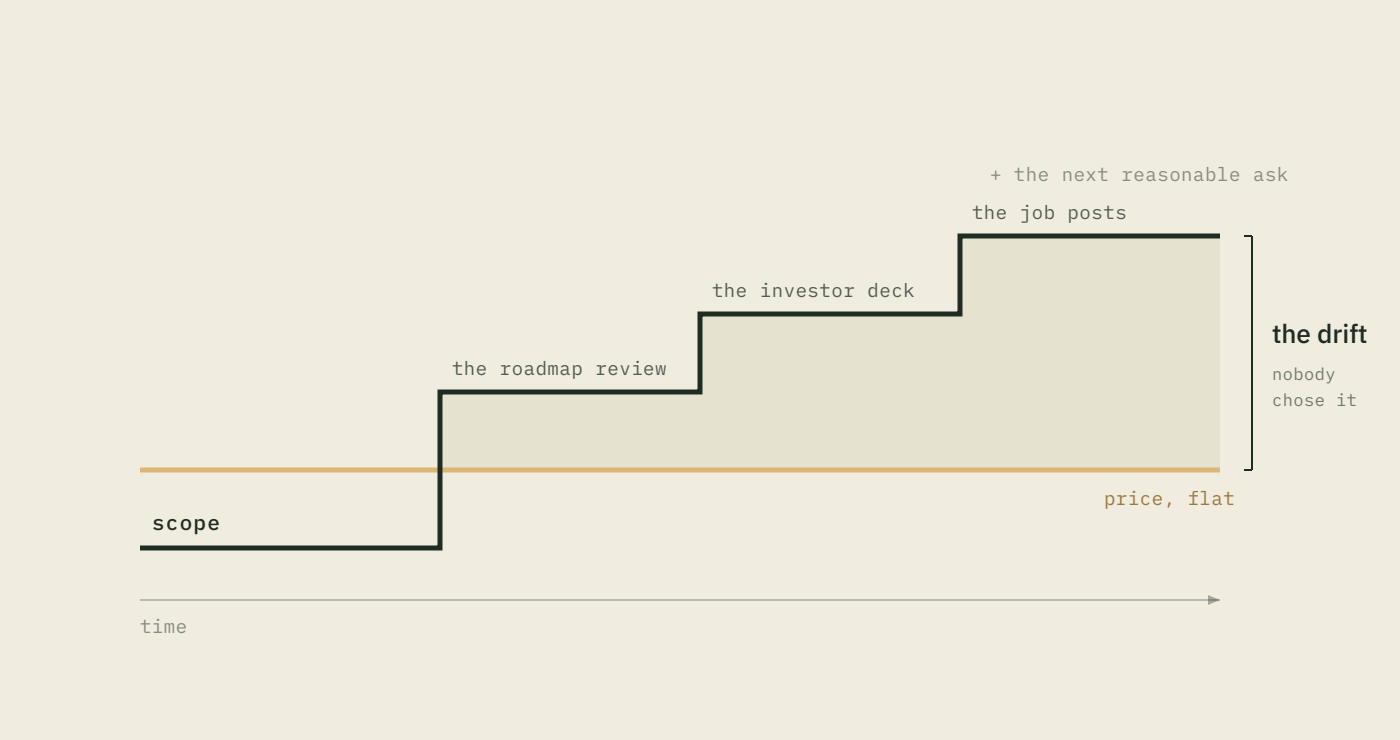
A menu can’t show drift. A menu is a list of things you can order, and it works at a restaurant because dinner ends. You compose the meal and the kitchen cooks it. Everyone goes home. Fractional work doesn’t end after one seating. Run a practice on menu logic and you get the table that stays occupied for a year, ordering appetizers one at a time, while the kitchen wonders when it agreed to this.
A product behaves differently. A product has designed behavior: what it does, and what happens at the edges. States. Transitions. The moment where the system says: this is a different thing now, and we should both know it.
I’ve written before about scope markers, the small signals in AI products that show a person what the system heard and what it’s working on. Building the engagement page, I kept reaching for the same primitive. The client relationship needed what the products need: a legible view of what’s in motion, and a named moment when the shape of the work changes. Decision infrastructure, pointed at the practice itself.
So the page I shipped is short. It does three things:
It names what’s being bought: judgment, not hours for hire.
It names the floor: engagements start at $20K a month.
It makes the one promise a menu never makes: scope gets decided in conversation, and re-decided the same way when the work changes.
No tiers with clever names, at least not yet. The design is simpler than tiers: transitions are explicit instead of ambient. If the work outgrows the shape we named, the model should make that visible while it’s still a small fact.
My read, with an asterisk on it, because I am exactly one client into running this model: drift is a legibility problem before it’s a pricing problem. Most founders aren’t trying to extract free work. They can’t see the meter, because nobody built one. When scope is visible, the awkward conversation shrinks into a normal one.
I don’t know yet whether the model holds. The floor might be wrong. Scoping in conversation might be a thing I revisit at client five, whenever client five arrives. But I’ve started treating the engagement page as the first product a client touches, and building it like one. If the model is wrong somewhere, and it probably is somewhere, the wrongness will surface in a conversation instead of a resentment.