
Conversations have structure. AI products show them as flat.
The missing primitive isn’t a fork. It’s a bookmark.

Originally published on Medium, May 27, 2026
You’re twenty messages into an AI conversation. The first eight were productive. You framed the problem, narrowed the scope, got the system oriented. Then you explored a tangent. The tangent was useful but it pulled the conversation sideways. Now you want to go back to message eight, to the moment the scope was right, without losing the tangent work.
You can’t.
You can scroll. But scrolling through twenty messages to find the one where the scope shifted doesn’t work. The messages look the same. There’s no marker. No signal that says “this is where the conversation changed direction.”
You can search by keyword. But you don’t remember the keyword. You remember the moment. The moment where you said “actually, let’s focus on just the northeast region” and the system locked in. That moment was a structural event. The search bar doesn’t know that.
You can branch. Some products offer it. But branching is forking. It creates a parallel timeline. It’s heavyweight. You don’t want a parallel universe. You want to go back to a point in this one.
You can ask the system to recall it. But now you’re relying on the model’s memory to navigate a structure that the interface should have been showing you the whole time.
So you restart. You open a new conversation. You re-establish the context from scratch. You pay the tax.
Every other tool that deals with structured work has solved this.
Git has commits. Documents have version history. A podcast has chapters. A book has a table of contents. All of these share one thing: the history has structure and the structure is navigable.
The person can see where meaningful changes happened and return to those points.
AI conversations don’t have this. The history is flat. A scrolling list of messages with no structural markers. Every message looks like every other message regardless of whether it was a casual follow-up or a fundamental change in scope.
I’ve been working inside an AI product where people run long, multi-scope sessions. They start broad, narrow to a specific focus, pivot to a different angle, narrow further to a time window, then sometimes reset entirely. These are real structural events. The person’s intent shifts and the system adjusts.
I started mapping the pattern. There are roughly five types of scope change: the person narrows, the person broadens, the person pivots to a new topic, the system narrows (through a prompt asking for clarification), or the system broadens (by suggesting adjacent paths). Each one is a structural event in the conversation. A chapter marker.
None of them are visible in the interface.
The missing primitive is a scope event marker. A point in the conversation where the scope changed, rendered as something navigable. Not a branch. Not a fork. A bookmark that says “here’s where the conversation turned.” Click it and you return to that scope state. The work between here and there stays intact. You’re not undoing. You’re navigating.
The missing primitive isn’t a fork. It’s a bookmark. You’re not undoing. You’re navigating.
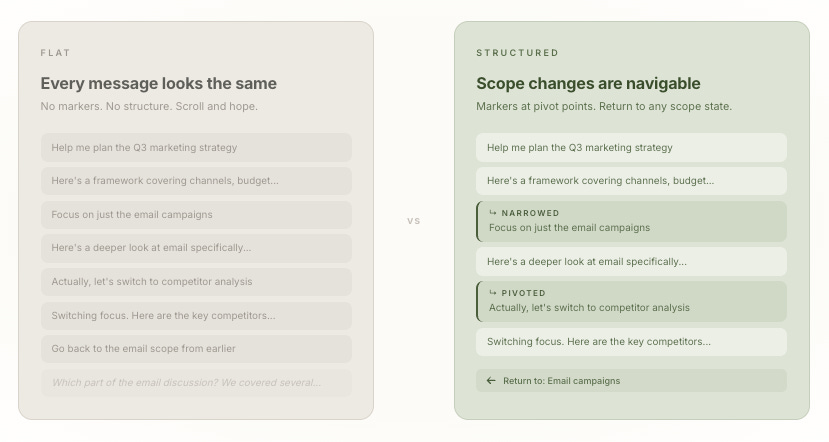
I think there’s something bigger underneath this. A conversation is a sequence of states. Each scope change is a turning point. What you’d end up with is something that looks a lot like version history for conversations. The structure of the thinking itself becomes visible and navigable.
Conversations have structure. Branching creates alternatives. This creates a map of what already happened. The person can see their own decision path through the conversation and return to any point on it.
Long conversations break down today because the interface doesn’t show the person where they’ve been. People restart to reset. The cognitive cost of re-establishing context is the real tax. And the future of AI work is long-running, multi-scope conversations where the accumulated context is the value.
Losing it because the interface can’t navigate its own structure is a solvable problem.